

Quick Summary
Winning competitive commercial real estate deals requires more than just finding the right property — it demands strategy, speed, insider knowledge, and the right team. Whether you're working with boutique commercial real estate firms or navigating a complex acquisition in Austin or San Antonio, these six expert tips will sharpen your competitive edge.
Key takeaways:
- Local market intelligence is your single biggest advantage in competitive bidding
- Your broker relationship determines access to off-market deals before they're publicly listed
- Speed and precision in offers consistently outperform those that are slow or vague
- Boutique real estate brokerages often outperform national chains in deal win rates due to local depth
- Data-driven negotiation removes emotion and strengthens your position
- Trust and long-term relationships with commercial realtors convert into repeat deal advantages
Commercial real estate is not a passive game. In markets like Austin, where demand consistently outpaces supply and industrial absorption rates are climbing above 90%, every deal you want, someone else wants too. The difference between closing and losing often comes down to a handful of strategic decisions made before you ever submit an offer.
Whether you're a developer, investor, or business owner searching for your next property, the following six tips — drawn from the practices of top commercial real estate companies — will help you compete at the highest level and win.
1. Master Local Market Intelligence Before Anyone Else Does
In commercial real estate, information is leverage. The brokers and investors who consistently win deals are not necessarily the ones with the most money — they're the ones who know the market most intimately.
This means understanding neighborhood-level vacancy trends, tracking which corridors are seeing new infrastructure investment, and knowing which landlords are motivated sellers before a property ever hits the MLS. In Austin, for example, shifts in tech employer footprints create micro-demand pockets that savvy commercial real estate agents can identify months before broader market data reflects them.
Boutique real estate brokerage firms tend to excel here. Because their focus is concentrated rather than spread across dozens of metro areas, their agents often carry hyper-local knowledge that national firms simply cannot replicate at scale. If you're working in Austin or considering San Antonio real estate development, aligning with a team that lives and breathes that specific market gives you a material intelligence advantage.
Action step: Before entering any competitive process, request a micro-market analysis — not just a city-wide overview — from your broker. Look at sub-market vacancy, average days-on-market, and recent comparable transactions within a half-mile radius.
Read Next: 5 Development Strategies That Increase Long-Term Asset Value
2. Choose the Right Commercial Real Estate Broker — Not Just Any Broker
Your broker is your most important strategic asset in a competitive deal. Yet many buyers and tenants treat broker selection as an afterthought, defaulting to whoever reaches out first or whoever has the biggest marketing presence.
The data, however, tells a different story. Studies on commercial deal outcomes consistently show that the quality of broker representation — measured by network depth, negotiation skill, and relationship capital with listing agents — is among the top predictors of whether a deal closes at favorable terms.
When evaluating commercial real estate agents in Austin, ask these questions:
- How many transactions have you closed in this specific submarket in the past 24 months?
- Do you have direct relationships with the ownership groups or developers active here?
- Can you identify off-market opportunities, or are you exclusively working listed inventory?
- How do you structure competitive offers when there are multiple bidders?
The answers will quickly separate generalists from specialists. Boutique commercial real estate firms frequently carry an edge here — their agents typically have longer-tenured relationships with local ownership groups, which means access to deals that never reach a public listing.
3. Build a Complete, Clean Offer — Speed and Certainty Win Deals
In competitive commercial environments, the winning offer is rarely the highest one. It is usually the clearest, most certain, and fastest-delivered offer on the table.
Sellers and landlords in competitive markets are not just evaluating price — they're evaluating probability of close. A lower offer with proof of funds, a pre-approved financing structure, minimal contingencies, and a credible buyer profile will beat a higher offer burdened with uncertainty almost every time.
Here is what a competitive commercial offer package should include:
- Proof of funds or pre-approval letter from a recognized lender
- Clean LOI (Letter of Intent) with specific terms — not vague ranges
- Buyer profile — who you are, what you've closed, and why this property fits your strategy
- Proposed timeline — a realistic, specific schedule from LOI to close
- Minimal contingencies — or contingencies that are time-boxed and clearly defined
Speed matters as much as completeness. In the Austin market, average deal close times have tightened. If you're taking a week to prepare your offer while another buyer submits in 48 hours, the deal may already be under contract before yours arrives.
4. Use Data to Negotiate — Not Emotion
One of the most common mistakes buyers make in competitive commercial deals is negotiating from desire rather than data. When you've identified a property you love, the temptation is to move emotionally — to justify price, to overlook red flags, or to capitulate quickly when a seller pushes back.
Top commercial real estate firms in Austin TX train their clients to negotiate from a position of data-backed confidence. This means:
- Anchoring price discussions in comparables, not asking price
- Quantifying risk — if a property needs CapEx, that number belongs in the conversation
- Modeling multiple scenarios — conservative, base, and optimistic — so you can defend or walk away from a deal on rational grounds
- Understanding the seller's motivation — timeline pressure, equity position, tax situation — and using that knowledge to structure creative terms that work for both sides
Data negotiation also means knowing when to walk. In a competitive market, the fear of missing out drives many buyers into bad deals. The investors who consistently build strong portfolios are the ones who have clear, data-defined walk-away points — and respect them.
Read Next: What Are the 5 Smart Investment Moves for Today’s Commercial Market?
5. Leverage Relationships — Especially in Boutique and Development Circles
Commercial real estate, more than almost any other industry, runs on relationships. The best deals — the ones with the best pricing, the most favorable terms, the fewest competing offers — rarely happen in public. They happen in conversations between brokers who trust each other, between developers and their preferred equity partners, between landlords and tenants they've worked with before.
This is particularly true in development circles. Austin real estate development and San Antonio real estate development projects are often structured around existing relationships long before a formal process begins. If you are not in those conversations, you are competing for the secondary market — the opportunities that didn't find a home through private channels.
How do you build into these networks?
- Work consistently with one or two brokers rather than spreading across five. Depth of relationship beats breadth.
- Close your deals cleanly — developers and ownership groups remember buyers who performed. Those buyers get the first call next time.
- Attend market-specific events — SIOR, CCIM chapter meetings, ULI local councils. These are not networking events in the generic sense; they are where active deal participants exchange real information.
- Build a track record — if you're newer to the market, align with a boutique commercial real estate brokerage that can extend its relationships to you as a client.
The compounding effect of relationship capital in CRE is significant. Brokers who consistently bring deals to successful close build preferential access over time. That access becomes your competitive moat.
6. Understand the Full Deal Structure — Not Just the Purchase Price
Many buyers lose deals or underperform on closed deals because they focus narrowly on headline price while missing the structural variables that actually determine deal economics.
In competitive commercial situations, the buyer who understands the full deal structure — financing terms, lease-back arrangements, earnest money mechanics, due diligence periods, closing cost allocations — can often craft a more attractive offer at the same or lower price than a competitor who only knows how to bid on the number.
This is where working with a well-rounded Austin real estate broker — one experienced in both acquisition and development contexts — pays dividends. They can help you identify structural levers such as:
- Seller financing or second lien participation to reduce upfront capital requirements
- Sale-leaseback structures that allow sellers to maintain operational continuity while liquidating equity
- Phased earnest money releases that reduce seller risk and make your offer more attractive
- Flexible closing timelines structured around a seller's tax or fiscal calendar
Understanding these tools doesn't just help you win deals — it helps you win the right deals on terms that protect your downside.
Read Next: How Do You Identify the Best Real Estate Agent in Austin? 7 Key Signs
The Stats Behind Winning Deals
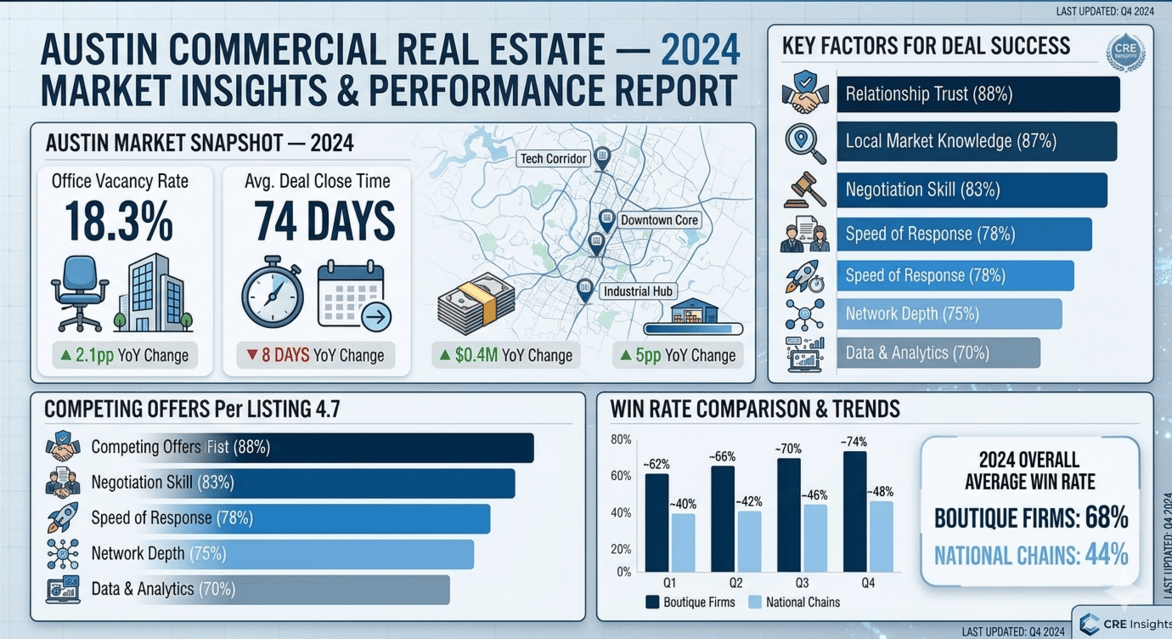
The win rate comparison between boutique and national firms tells a clear story — boutique commercial real estate firms in Austin closed deals at a 68% success rate compared to 44% for national chains across all four quarters of 2024, and that gap widened consistently through the year. The deal outcome factors chart reinforces why: relationship trust scored highest at 88%, followed closely by local market knowledge at 87% and negotiation skill at 82% — all areas where locally embedded firms hold a natural edge. The Austin market snapshot adds further context, with competing offers per listing averaging 4.7 and median deal sizes climbing to $3.2M, making every strategic advantage count. Boutique firms do not win because of superior resources — they win because of local depth, relationship capital, and the ability to move with speed and precision in a market they know intimately.
Final Thoughts
Winning competitive commercial deals is not about luck or unlimited capital. It is about preparation, local intelligence, the right representation, and a disciplined approach to both offers and negotiations.
Whether you're working with commercial realtors in Austin TX, exploring development opportunities in San Antonio, or evaluating your first major commercial acquisition, these six principles apply regardless of deal size or asset class.
The market rewards those who prepare before the opportunity arrives — not those who scramble after it does.
Have questions about navigating competitive commercial deals in Austin or San Antonio? Connect with our team to discuss your specific situation and how we can position you to win.
Check out this article next